Services · AI & Machine Learning
AI Agent Development
Agents that act only through an approval gate
What this is
What ai agent development covers
AI agent development for back-office and operations teams that need multi-step work done inside existing systems: claims platforms, core banking, exchange venues, ticketing, and ERPs. We build agents on durable workflow engines with tool allowlists, run them in shadow mode against what operators actually did, and only then route recommendations to an approval inbox. Money, safety, and publish actions stay human-gated until agreement data says otherwise.
Typical timeline: 6–14 weeks
Who hires us for this
- Heads of operations and payments running exception queues measured in minutes per item
- Trading and treasury desks that want operator-approved actions across venues
- Platform teams who inherited an RPA estate that breaks on every UI change
Problems we get hired for
What usually goes wrong before we are called
The agent calls tools that do not exist
Free-form tool use produces invented API calls. We expose tools through MCP servers with strict schemas, so the agent can only call what the allowlist defines.
A retry double-posted a payment
Agents without durable execution repeat side effects. Temporal workflows make every step idempotent and resumable, with the LLM only at classification and drafting steps.
Nobody can explain what the agent did last Tuesday
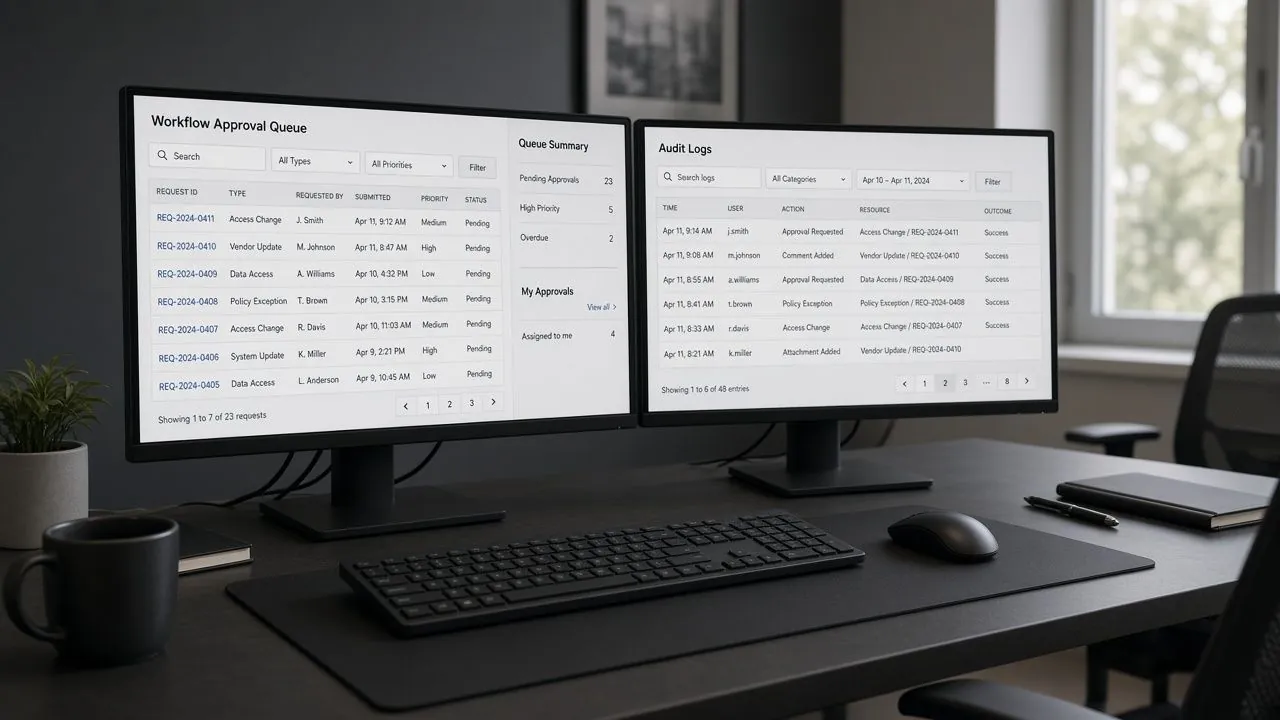
Every recommendation, approval, and override is sealed to an append-only log with the prompt, tool inputs, and operator identity. Audit asks are answered from the log, not from memory.
How the engagement runs
Steps and the artifact each one produces
- 01
Connect
Read-only integration with the system of record and the queue. Tool schemas drafted with your API owners.
Artifact: Integration map and MCP tool catalog
- 02
Shadow
The agent produces recommendations that are logged next to operator actions for two to four weeks. Nothing is written.
Artifact: Agreement report by exception type
- 03
Assist
Recommendations appear in an approval inbox. Operators approve, hold, or override. Overrides feed evals.
Artifact: Approval inbox, audit log, eval suite
- 04
Scale
Exception types with sustained agreement graduate to auto-approve within thresholds your risk team owns.
Artifact: Threshold policy, runbooks, on-call guide
Stack
Tools we reach for
Chosen per engagement against your existing platform. Nothing here is mandatory; everything here has shipped.
| Orchestration | Temporal · LangGraph · Vercel AI SDK |
|---|---|
| Tools | MCP servers · JSON Schema validation · Per-tool rate limits |
| Models | Claude · GPT-4 class · Llama 3 and Qwen for VPC deployments |
| Trust | Approval inbox (Next.js) · Append-only audit log · Xenith Seal for signed decisions |
| Evals | Replay of logged cases · Agreement-rate dashboards · Override taxonomy |
What you receive
Deliverables
- Agent architecture with tool allowlist and schemas
- Durable workflow implementation with idempotent steps
- Approval inbox and append-only audit log
- Shadow-mode agreement report
- Eval suite, runbooks, and threshold policy
Proof
Where this has run
Banking
Durable AI Ops Layer for Mid-Market Banking
KYC exceptions and payment repairs on Temporal + Vercel AI SDK + MCP: maker-checker Signals, PII redaction, zero double-posts on core retries.
Payment exception handle time: 45–90 min median → 12–25 min median
Crypto / FinTech
Durable AI Ops Layer on Multi-Venue Exchanges
Desk copilots that turn natural-language intent into HITL-approved exchange orders (Vercel AI SDK, Temporal, and MCP) without YOLO trading bots.
Ticket prep time (desk): 15–40 min / intent → 2–5 min review
Insurance
Claims Intake Routing & Data Extraction
FNOL packs auto-classified and routed: adjusters cut intake from ~45 minutes to ~5–8 on standard claims.
Intake time (standard claims): ~45 minutes → ~5-8 minutes
Products that ship inside this service
- Xenith Agents · Scoped multi-step workflows with human gates on irreversible steps.
- Xenith Seal · Proof-layer for autonomous AI - every decision cryptographically sealed.
Engagement models
How we can be hired for this
| Model | Shape | Typical duration |
|---|---|---|
| Fixed-scope pilot | Defined workflow, defined integration points, defined exit metric. Priced as a project. | 4–12 weeks |
| Production retainer | Monthly capacity for evals, monitoring, model refreshes, and new workflows. Month-to-month. | 3+ months |
| Embedded pod | One architect plus two to four senior engineers working inside your repos and rituals. | 3–9 months |
Pricing and phase gates are described on How we work.
Questions buyers ask
Frequently asked questions
- Why not let the agent act autonomously from day one?
- Because the cost of a wrong write in a payment, claims, or trading system is asymmetric. Shadow mode produces agreement data in two to four weeks; that data, not a vendor promise, decides which exception types can auto-approve. In the mid-market banking deployment, payment exception handling moved from 45–90 minutes to 12–25 minutes with humans still approving every release.
- Which frameworks do you use?
- Temporal for durable execution, LangGraph or the Vercel AI SDK for the reasoning loop, and MCP servers for tools. We pick per workflow; the framework matters less than idempotent steps and a strict tool schema.
- How is this different from RPA?
- RPA scripts a UI and breaks when it changes. These agents call APIs through typed tools and reason over unstructured inputs, so they handle the exception paths RPA falls over on. We often run both: RPA for the deterministic 80%, an agent for the exceptions.
- Can the agent run without sending data to a model vendor?
- Yes. For PII or residency constraints we deploy Llama 3 or Qwen class models inside your VPC or on-premise through Xenith Private AI. The banking case study kept all customer data in-region.
- What does the approval inbox look like to an operator?
- A queue with the recommendation, the reason, the source signals, a confidence band, and Approve, Hold, and Override buttons. Overrides require a short reason code that feeds the eval suite. The homepage hero shows a demo of this pattern.
When this is the wrong fit
- Consumer chatbots or marketing copy generators; there is no system of record to gate.
- Teams that want full autonomy in week one without a shadow phase.
Next step
Send the workflow. We reply with an architecture sketch.
Describe the queue, the system of record, and who signs off today. First brief is free; NDA first if you prefer.