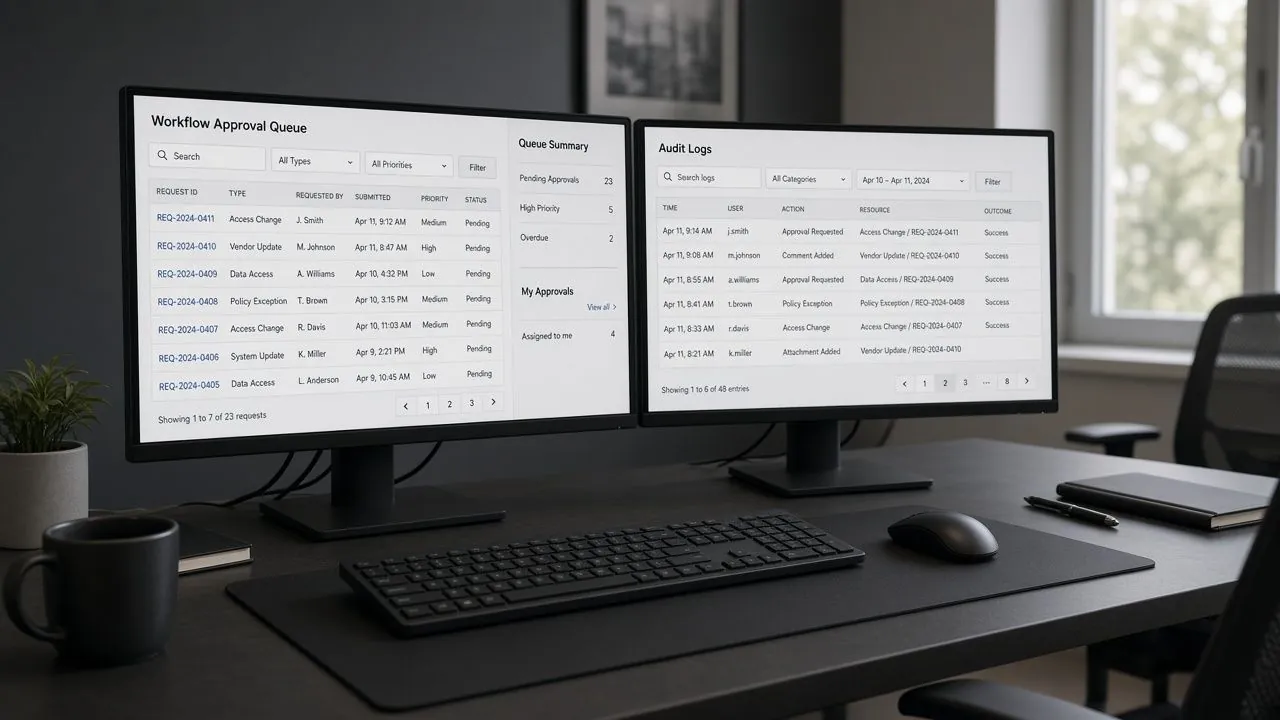
Enterprise AI agents: architecture, safety, and production use cases
Drawn from Xenqube deployments across regulated workflows. Covers agent architecture, failure modes, human-in-the-loop gates, and how to ship agents safely.
Quick Summary
AI Agent: An AI agent is an LLM-based autonomous system that takes an objective, reasons about how to achieve it, calls external tools (APIs, databases, search engines), observes the results, adjusts its approach, and iterates - without per-step human instruction. Unlike a chatbot, an agent operates across many steps toward a goal and can take real-world actions.
- ·AI agents use tool calling to interact with external systems - databases, APIs, web search, code execution
- ·They differ from chatbots by being goal-oriented and multi-step, not request-response
- ·Production-grade agents require step limits, tool validation, audit trails, and human-in-the-loop gates
- ·Common frameworks: LangGraph (stateful workflows), LangChain (RAG pipelines), AutoGen (multi-agent)
- ·Enterprise use cases: claims processing, contract review, market research, compliance monitoring
- ·A 20-step agent task running unmonitored can take real-world actions with real consequences
How AI Agents Work: The Five-Layer Architecture
Every production-grade enterprise agent system we build uses the same layered architecture. Skipping any layer causes specific, predictable failure modes.
Application Layer
User-facing interface - chat UI, API endpoint, embedded widget, or automation trigger. Should be thin; all intelligence lives below.
Orchestration Layer
The agent brain - handles planning, tool selection, step sequencing, and state management. LangGraph for stateful workflows; direct orchestration for performance-critical systems.
Tool Layer
The agent's hands - every external capability is a tool with strict input/output schemas. Every tool call is validated and logged.
LLM Gateway
Routes every LLM call with model selection, rate limiting, semantic caching, retry logic, and cost tracking. Critical for enterprise reliability.
Foundation Layer
Data and observability infrastructure - vector databases, structured databases, audit logs, monitoring.
Non-Negotiable Production Requirements
These are not best practices - they're the minimum for any agent system running on real data with real consequences.
- Hard step limit (max 25 steps - circuit breaker)
- Tool call validation on every parameter before execution
- Immutable audit trail: every call, input, output, timestamp
- Human-in-the-loop gate for all irreversible actions
- Per-tool timeout with defined fallback behavior
- Semantic caching for repeated sub-queries (saves 30-50% cost)
- Version control for prompts (treat as code)
The Five Failure Modes
Every production agent failure clusters into one of these five patterns. Know them before you build.
- Infinite loops: Agent keeps replanning without acting - prevented by hard step limits
- Tool hallucination: Agent invents parameters or API calls - prevented by strict validation
- Cascading errors: Wrong tool output leads to wrong assumptions in all subsequent steps
- Context overflow: Agent forgets earlier decisions as history fills the context window
- Latency variance: P99 latency 10-20x the median - users retry and create duplicate runs
AI Agents - Frequently Asked Questions
Answers to the most common questions about building and deploying AI agents in enterprise environments.
What is an AI agent?
An AI agent is an LLM-based system that takes an objective, reasons about how to achieve it, calls external tools (APIs, databases, search engines), observes the results, and decides on next steps - autonomously, without step-by-step human instruction. Unlike a simple chatbot that responds to a single query, an agent operates across multiple steps toward a goal.
How do AI agents differ from AI chatbots?
A chatbot is request-response: one query in, one answer out. An AI agent is goal-oriented: it receives an objective, plans, calls tools, observes results, replans, and iterates until the goal is achieved or a limit is reached. Agents can write code, browse the web, query databases, send emails, and trigger other systems.
What are the most common enterprise AI agent use cases?
Insurance claims routing and data extraction, contract review and risk flagging, market research pipelines, customer onboarding orchestration, compliance monitoring, procurement analysis, support ticket resolution, code review and security scanning, and report generation from multiple data sources.
How do you ensure AI agents don't take harmful autonomous actions?
Through hard step limits (the agent cannot run indefinitely), tool call validation (every parameter validated before execution), human-in-the-loop gates (approval required before irreversible actions like sending emails or updating production records), immutable audit trails (every action logged), and graceful degradation (defined behavior for every failure mode).
What frameworks does Xenqube use to build AI agents?
LangGraph for stateful, multi-step workflows with human-in-the-loop gates and checkpoint/resume capability. LangChain for simpler RAG pipelines. AutoGen for multi-agent coordination tasks. Direct API orchestration for high-performance systems where framework overhead matters.
How long does it take to build an enterprise AI agent?
A single-agent system for a specific workflow: 4-8 weeks for a production-ready POC. A multi-agent system with human gates, monitoring, and security controls: 2-4 months. Enterprise-grade agent platform with multiple workflows: 4-12 months.