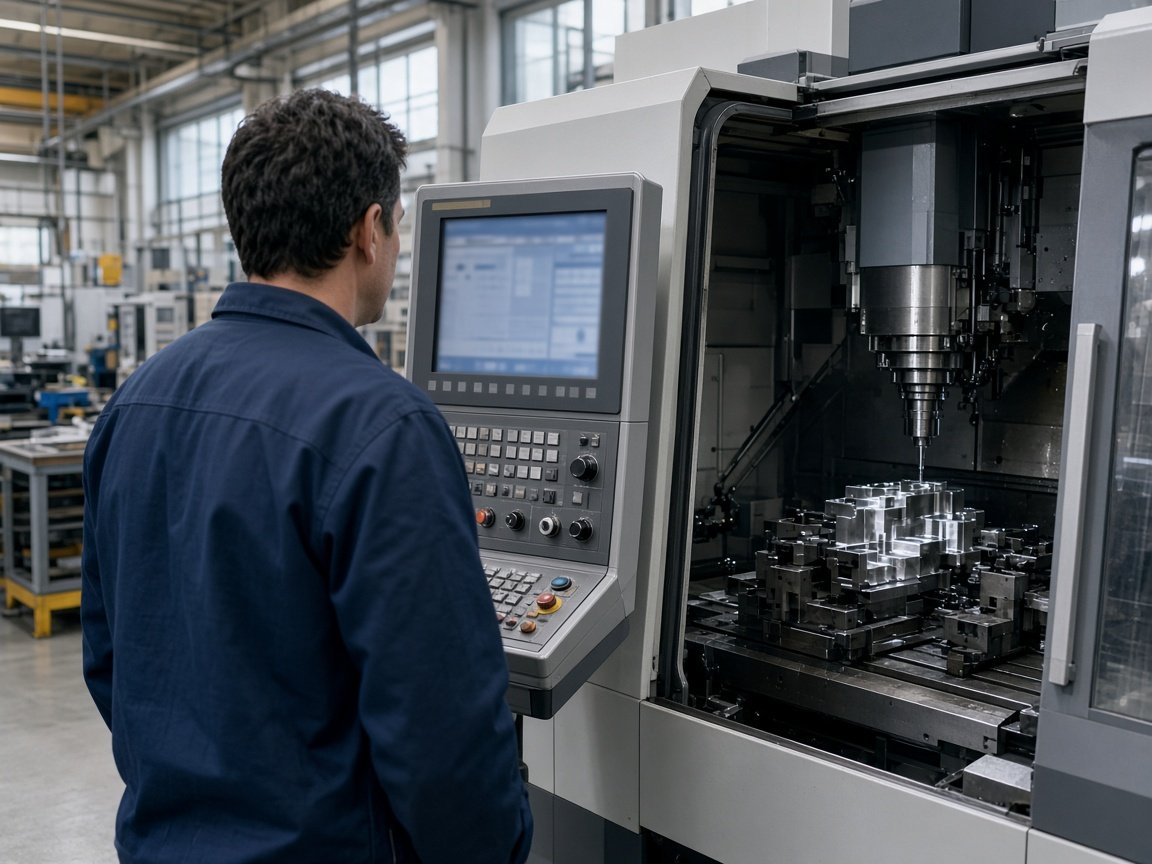
Walk a discrete manufacturing plant with a "digital twin" budget and you will eventually be shown a beautiful 3D model. Lighting is perfect. Cameras orbit. Executives nod. Operators shrug and go back to the HMI that actually matches the cell.
A twin operators can act on is not a render. It is an identity-stable asset graph with live protocol feeds, historian context, alarms, and an auditable write path. Pretty geometry is optional. Live state is not.
That distinction is why we built Xenith Twin as an Asset Administration Shell desk—factory → line → cell—not as a CAD theater. It sits inside our industrial AI work for manufacturing teams who are done buying visualization that never closes a work order.
The Confusion That Burns Budget
Vendors overloaded "digital twin" until it meant anything from a STEP file to a full closed-loop controller. Procurement hears "twin" and pictures a digital replica. OT engineers hear "twin" and ask four questions that kill most demos:
- Does every asset keep a stable ID when connectors change?
- Are we reading live OPC-UA / MQTT / historian data, or a nightly CSV?
- Can an operator acknowledge an alarm and open a work order with a signed identity?
- What is explicitly not in scope—PLC write-back, HA, predictive RUL?
If the pitch cannot answer those, you bought a visualization project with an AI sticker.
We take a harder stance in Zero-LLM-Trust: live equipment state and signed writes are deterministic commitments. Language models can explain OEE dips; they do not invent spindle loads or silently write setpoints.
Minimum Viable Industrial Twin
For discrete cells—automotive tier-1 CNC/robot lines, secondary packaging—the minimum that earns operator time looks like this.
Identity-stable shells
Asset Administration Shell patterns (BaSyx-style) give you a portable identity and submodels that survive a connector swap. Simulated cells in a PoC and production PLCs later should not force a rename festival. If asset IDs churn when you leave the demo plant, you never had a twin—you had a prototype with amnesia.
Protocol truth, not spreadsheet truth
OPC-UA for CNC and robot controllers. MQTT for line events. Historian for the time axis operators already trust. OEE computed from equipment state beats OEE typed into a weekly Excel that everyone knows is political.
Alarm and action loop
A twin that only displays alarms is a prettier SCADA mirror. Operators need ack paths and work-order hooks with JWT-backed writes—who did what, when. That is the difference between "awareness" and "operations desk."
Twin health as a first-class signal
Protocol lag, stale shells, and missing feeds should be visible. Teams that skip twin health discover weeks later that they were optimizing on a frozen world.
Photoreal plant CAD, IEC 62443 hardening, and closed-loop write to real PLCs can be roadmap items. Shipping them as day-one claims is how PoCs die in security review. Integrate-don't-replace applies: extend MES/OT; do not pretend the twin replaces them. More on that posture in integrate, don't replace.
Simulated Cells Are a Feature—If You Say So
We ship PoC slices with simulated manufacturing cells on a shared campus pattern on purpose. Security teams should not open plant networks for a first desk walkthrough. The honest path is:
- Prove the desk UX and AAS inspector on simulated AutoDrive-style and packaging-style cells.
- Document the connector swap plan for real PLCs without changing asset IDs.
- Turn on signed writes for approved actions only.
- Measure twin health against live feeds before anyone talks about optimizer autonomy.
Label the simulation. Operators respect honesty. Executives who demand "real plant data on day one" without a network path are asking for a compliance incident.
Shadow Mode thinking still applies even when the twin is mostly read-path: log recommended acks and work orders before Assist writes. See shadow mode before assist.
Where AI Belongs on a Twin Desk
Once live state exists, AI earns a seat—narrowly.
Useful: narrating why OEE dropped on cell AS-07 using cited historian windows; drafting a work-order description from alarm clusters; answering "which shells are stale?" with twin-health metrics.
Not useful: inventing a predictive remaining-useful-life number with no failure library; auto-writing CNC parameters because a model is "confident"; replacing the MES as system of record.
Xenith Agents patterns fit the narration and multi-step diagnosis. Xenith Seal patterns fit when a regulated plant needs sealed proof of an approved write. Neither replaces OPC-UA.
Spatial context from cameras is a sibling concern, not a substitute twin. When CCTV should feed a living spatial model and HITL actions, that is Xenith Spatial—not a prettier CAD overlay. Pair the posts: this one for AAS desks, CCTV to spatial action loops for vision tiers.
Buyer Checklist for Twin RFPs
Steal this. Put it in the RFP.
- Require AAS or equivalent identity model with a connector-swap story.
- Require named protocols (OPC-UA, MQTT, historian)—not "IoT connectors."
- Require operator write authn/z and audit on acks and work orders.
- Require an explicit non-goals list (no fake PLC closed-loop on day one).
- Require twin-health metrics in the UI, not only process KPIs.
- Require synthetic-vs-live labeling in every demo.
- Ask how governed AI constraints apply before any autonomous setpoint path.
Programs that pass this checklist still move fast. They just stop confusing cinema with control.
What Good Looks Like After Six Months
Cell leads open one desk across plants instead of three HMIs and a shared drive. Plant IT can swap a connector without breaking dashboards. Alarm-to-work-order time drops because the loop is in the twin, not in a chat thread. Leadership stops asking for "more 3D" and starts asking for fresher shells and tighter approval SLAs—which is the correct conversation.
If your twin cannot survive the operator shrug test, it is not a twin yet. Fix identity, protocols, history, and signed actions before you buy another render pass.
Xenith Twin is a multi-plant cell desk operators can act on—live AAS and protocols, not a pretty 3D model.
Request an architecture brief → · Xenith Twin → · Manufacturing AI →